
Author: sonali

  • Drones Over the Fence: Why Autonomous Aerial Threats Are Rewriting Physical Security Playbooks

    Drones Over the Fence: Why Autonomous Aerial Threats Are Rewriting Physical Security Playbooks

    Drones Over the Fence: Why Autonomous Aerial Threats Are Rewriting Physical Security Playbooks

    For many years the fence, guard and camera formed the backbone of the of physical security. However, none of them, looked up. 

    Drones also known as unmanned aerial systems (UAS) are considered as a rapidly evolving threat to vital National Infrastructure across the UK.  Ministry of Defence, UK, reports that in 2025 alone, there were more than 250 drone incidents near military areas.   Drone strikes near airports increased by more than 25% in the first quarter of 2025, as compared to 2024. As a result of this, airspace infractions are now considered as operational threats by security personnel. 

    There is an increase in the risk exposure for power plants, substations, prisons and aviation centres. Drones are becoming an attractive tool for the criminal groups as they can be used for both surveillance and target physical attacks. Every security leader now, must answer this question: 

    Is current security architecture capable of identifyingevaluating and reacting to the growing aerial threats? 

    Why Is Traditional Security Architecture Failing?

    With the increase in the security breach incidents, organisations have made significant investment in ‘Perimeter Security’ including ground-based monitoring systems, CCTV and access control, all of which are considered as the part of traditional security framework. 

    Since these were created to fight for two-dimensional security threats, they still are crucial precautions.  Majority of the current security frameworks were not designed to fight the third-dimension attacks in which the drones operate. 

    A drone not necessarily use a gate or turn off an alarm. While staying completely out of sight from ground-based monitoring systems, it can survey map and deliver a payload. Legal frameworks regarding this new threat are still in development phase, a new restriction on unmanned aircraft came into effect from January 2026. When threats are present and increasing rapidly, the organisations cannot afford to wait for the regulations to direct the response.
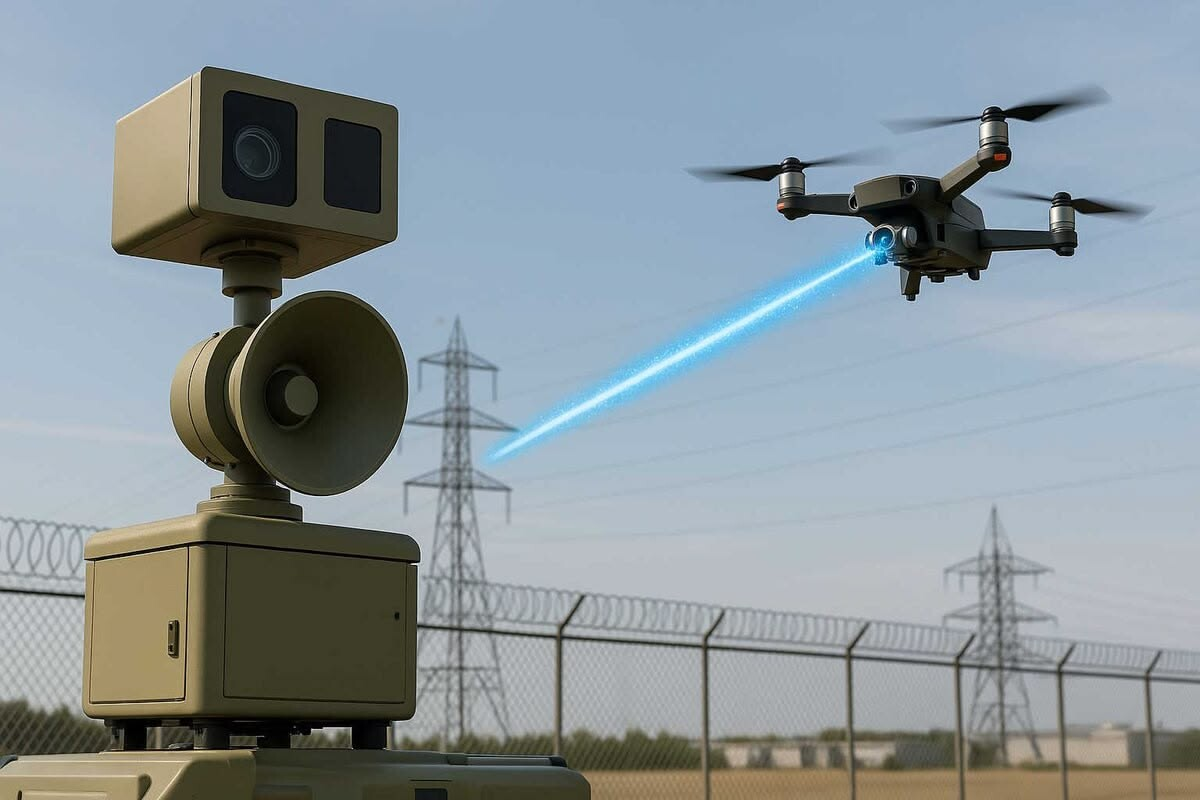
    What Does an Integrated Counter Drone System Look Like?

    The first step to building an effective counter drone system is detection, which integrates radar, radio frequency systems (RF) systems, and visual analytics to spot the drones flying in or near a specific location. A threat needs to be analysed in real time, to differentiate between the hostile and authorised commercial drone before a response system is put action. 

    Over the next 10 years the global counter-drone market is predicted to expand with 30% annual growth rate, reaching $30.5 billion by 2034.  This is a clear signal of the scale of investment this threat demands across every sector. 

    Control Room: The Missing Link Here 

    The existing control rooms were not designed to act on airspace intelligence The detection systems completely fails if an air attack is spotted, but there is no coordinated mechanism to notify the concerned teams and work with external agencies in real time. Majority of the times due to lack of the effective response system, incidents are recorded after they have occurred. In such situations, even a short delay can have serious operational and safety consequences in environments like airports, prisons etc.

    To build an effective response mechanism, human element also plays major role. The operators need to be trained to identify threats, analyse airspace data, and take immediate actions in emergency situations. It is important to ensure that counter UAS systems should be installed in every critical area to prevent the risk from air attacks. 

    The Way Forward

    The physical security landscape across the UK and globally is rapidly changing due to this new form of threat i.e. Air threat or drone threat. The increase in the security challenges every year, is widening the gap between security architecture and aerial environment with more organised incidents by criminal networks. 
     
    The most of the hour is whether your control room can notice a drone flying over your premise and more importantly is your team prepared for the response to such threats.  
  • From Monitoring to Decision Making: The Role of the Modern Control Room

    From Monitoring to Decision Making: The Role of the Modern Control Room

    Monitoring to Decision Making, The Role of the Modern Control Room

    Organisations across the UK are operating in an environment where incidents are not only increasing in volume, but also in speed and complexity. In the past year alone, UK businesses experienced an estimated 8.58 million cybercrimes, while 20% of businesses reported at least one cyber incident, often facing repeated attacks. At the same time, nationally significant cyber incidents are now occurring at a rate of around four per week, highlighting how frequently organisations are required to respond under pressure.  

    Most organisations already have control rooms in place, bringing together systems, screens, and teams to monitor operations and manage incidents. However, when pressure builds and multiple issues unfold at once, these environments are not always designed to support fast, clear, and coordinated decision making when it matters most. Whether managing disruptions across critical infrastructure, transport networks, or large-scale facilities, the expectation is the same: respond quickly, stay aligned, and remain in control. 

    A more effective approach is to view the control room not just as a monitoring space, but as a decision environment. The focus shifts from how much technology is present to how clearly teams can interpret information and act on it. In high pressure situations, complexity slows response, while clarity enables it. 

    A human centric design plays a critical role in achieving this. Operators need to understand what is happening immediately, without navigating multiple disconnected systems. Information is structured to highlight priorities, guide attention, and support confident decision making. Every element within the control room serves a purpose, aligned to how people actually work. 

    Equally important is how teams come together. Incidents rarely sit within a single function. Security, IT, and operations must align quickly to manage impact. Environments that enable shared visibility across these functions allow teams to work from the same real time picture and respond as one. This reduces delays, removes duplication, and strengthens overall coordination.

    Operational efficiency is achieved by reducing unnecessary steps between detection and action. Integrated monitoring, intuitive layouts, and clearly defined workflows allow teams to move quickly without losing control. The aim is not speed alone, but precision and consistency in response. 

    Performance under pressure is also a key consideration. Control rooms must support sustained focus during critical events. Design elements such as layout, lighting, and ergonomics directly influence how well teams can maintain attention and perform over extended periods. 

    A well designed control room is not just a space. It is a strategic capability that reflects how an organisation prepares for and manages risk. It brings together people, processes, and technology in a way that supports better decisions in real time. 

    When designed with purpose, the control room becomes a place where complexity is managed, not amplified, and where teams are equipped to respond with clarity, confidence, and control. 

  • Building Border Resilience in an Era of Geopolitical Instability 

    Building Border Resilience in an Era of Geopolitical Instability 

    Building Border Resilience in an Era of Geopolitical Instability

    Border authorities now operate in an environment where global events can reshape passenger flows with very little warning. A political crisis, a sudden travel advisory, or instability in a particular region can quickly translate into diverted flights, surges in arrivals, and pressure on border control points. When that happens, the effects are felt first at the frontline. Arrival halls fill quickly, passport control queues lengthen, and officers must process travellers while working with incomplete or evolving information. In those moments, the resilience of a border system is tested by the quality of the intelligence and coordination supporting it.(add to the piece on land and maritime borders with freight traffic, coaches and foot passengers) Even brief disruptions in information flow can have operational consequences. If traveller data arrives late or intelligence updates fail to reach operational teams quickly enough, officers are forced to rely on partial information while maintaining throughput and security standards. The result can be slower processing, increased pressure on staff, greater risk of errors and so on. For this reason, resilience in modern border security extends far beyond physical checkpoints. It depends on how effectively intelligence, data, and operational systems work together to support decision making at the frontline.

    Situational awareness has become central to this process. Border authorities increasingly rely on systems that monitor travel patterns, flag potential risks before travellers reach the control desk, and provide officers with the information they need to make timely decisions. When these systems function well, higher risk cases can be identified earlier, allowing officers to focus attention where it matters most. 

    This approach helps maintain controlled throughput even during periods of disruption. Passengers continue to move through the system efficiently, while security checks remain targeted and proportionate. 

    Collaboration also plays a significant role in maintaining operational stability. Airlines, regional partners, intelligence agencies, and domestic law enforcement all contribute pieces of information that shape the border picture. When those insights are shared rapidly and integrated into operational systems, authorities gain a clearer understanding of emerging risks before they reach the border itself. 

    The practical benefit is straightforward. When emerging threats are visible earlier, authorities can adjust resources, strengthen screening where necessary, and manage passenger flows more effectively before disruption spreads across the border environment. 

    AI is now becoming very valuable in assisting control of border lanes, managing pedestrian and vehicular traffic queues to maximise efficiency and reduce delays, automatically detect left articles in xray scanner trays, over height baggage and dangers such as hands on conveyor belts. 

    A wholistic approach of fast throughput, lane optimization, and safe but fast use of scanners to provide real time actional intelligence to the relevant departments and personnel to react fast and proportionately. 

    The border is not limited to the checkpoints, it also consists of the physical barriers, be they sea, river  or fence and these must also be protected and monitored in real time, allowing for early detection and classification of threats from  persons, vehicles and even drones.  This can be effected by utilization of fence intrusion/climbing, ground sensors, radar looking across borders (and above to detect drones and aerial threats) , combined with optical and thermal cameras and even drones  for threat verification and real time monitoring/tracking of threats. 

    On a border of any length, these sensors can number in their thousands, making it a very complicate picture for human operators to monitor  and have full real time situational awareness of. Therefore control rooms and control solutions must be capable of monitoring the health status of the sensors and their activations and data sent, in real time to link and integrate sensors to give multi-factor intelligence such as, a sensor/radar detecting an object/event that might be a threat being linked to the correct and linked video feed from a camera/cameras and the launch of a drone to track and send live images of moving threats if it meets the threat response criteria. 

    AI and data-mining capabilities should be capable of monitoring and searching for individual or groups of persons/vehicles that are regularly passing or detected by sensors and compared to the known normal activities and events expected and learned from previous activities. 

    The required ability of the control solution for any border is to handle the myriad of normal activities, events, detections and daily happenings in real time, and to automatically and clearly show exceptions or possible threats to the relevant personnel monitoring and offer a preprogrammed and agreed operational procedure to react and counter them. 

    Ultimately, resilience comes down to how border security systems are designed. Some organisations still build their processes around stable conditions and treat crises as exceptional events. Others are beginning to recognise that instability is becoming a constant feature of the operating landscape.