
Drones Over the Fence: Why Aerial Threats Are Rewriting Physical Security
For decades, physical security strategies have been built around fences, gates, cameras and access controls. The assumption was that threats would approach from the ground. Drones have fundamentally changed that assumption.
Drones, also known as Unmanned Aircraft Systems (UAS), have emerged as a rapidly evolving security threat across critical infrastructure, industrial facilities and high-security sites. Ministry of Defence, reports that in 2025 UK, reports that in 2025 alone, there were more than 250 drone incidents near military areas. Drone strikes near airports increased by more than 25% in the first quarter of 2025, as compared to 2024. As a result of this, airspace infractions are now considered as operational threats by security personnel.
There is an increase in the risk exposure for power plants, substations, prisons and aviation centres. Drones are becoming an attractive tool for the criminal groups as they can be used for both surveillance and target physical attacks. Every security leader now, must answer this question:
Is current security architecture capable of identifying, evaluating and reacting to the growing aerial threats?
Where Do Traditional Security Systems Fall Short?
With the increase in the security breach incidents, organisations have made significant investment in ‘Perimeter Security’ including ground-based monitoring systems, CCTV and access control, all of which are considered as the part of traditional security framework. Since these were created to fight for two-dimensional security threats, they still are crucial precautions. Majority of the current security frameworks were not designed to fight the third-dimension attacks in which the drones operate.

A drone does not need to pass through a gate, breach a fence or defeat a perimeter alarm to gain access to a protected site. While staying completely out of sight from ground-based monitoring systems, it can survey map and deliver a payload. Legal frameworks regarding this new threat are still in development phase, a new restriction on unmanned aircraft came into effect from January 2026. When threats are present and increasing rapidly, the organisations cannot afford to wait for the regulations to direct the response.
What Does an Integrated Counter Drone System Look Like?
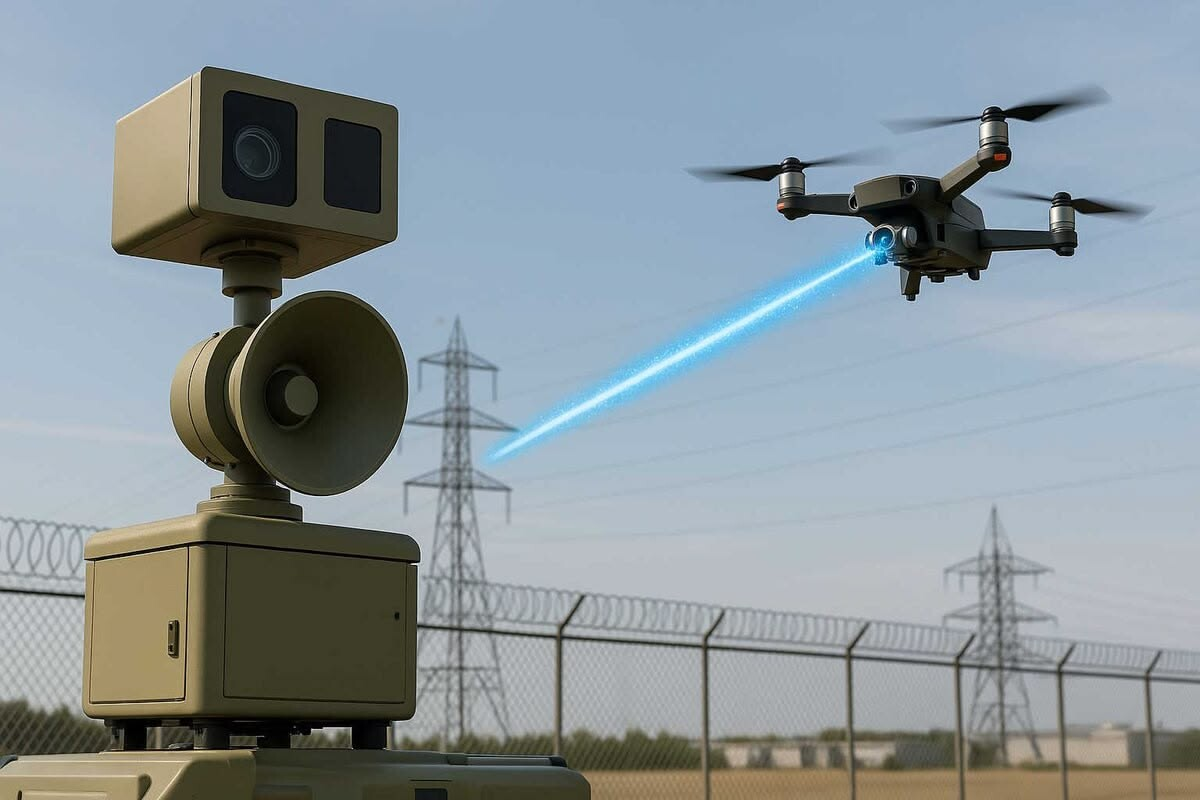
An effective counter-drone system begins with detection. Radar, radio frequency (RF) sensors and visual analytics can identify drones operating in or near a protected area. Each detection must then be assessed in real time to distinguish authorised activity from potential threats and determine the appropriate response.
Over the next 10 years the global counter-drone market is predicted to expand with 30% annual growth rate, reaching $30.5 billion by 2034. This is a clear signal of the scale of investment this threat demands across every sector.
The Control Room: The Critical Link in the Response Chain
Many existing control rooms were not designed to act on airspace intelligence. Detection system alone is insufficient if alerts do not reach the relevant teams and external agencies in time to coordinate a response. Majority of the times inefficient effective response system leads to recording the incidents after they have occurred. In such situations, even a short delay can have serious operational and safety consequences in environments like airports, prisons etc.
To build an effective response mechanism, human element also plays a major role. The operators need to be trained to identify threats, analyse airspace data, and take immediate actions in emergency situations. It is important to ensure that counter UAS systems should be installed in every critical area to prevent the risk from air attacks.
The Way Forward
The key question for security managers is no longer whether drones present a threat. The question is whether their organisation can detect, assess and respond to that threat in real time. Effective protection now depends on combining aerial threat detection, trained operators and clear response procedures within a single integrated security operation.